
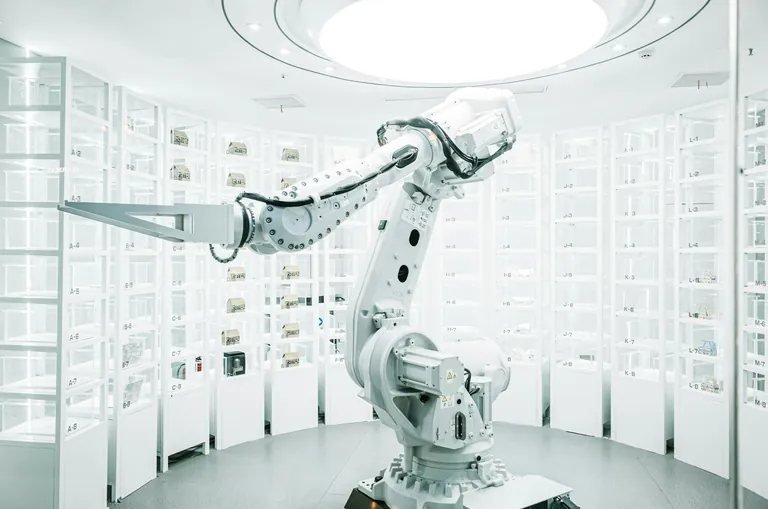
Industrial robotics has expanded from automotive welding and painting to material handling, inspection, packaging and machine tending. India’s manufacturing mix creates opportunities for both large robotic cells and compact systems suited to smaller factories. International experience suggests adoption is strongest when automation solves a measurable production bottleneck.
Market evidence and growth indicators
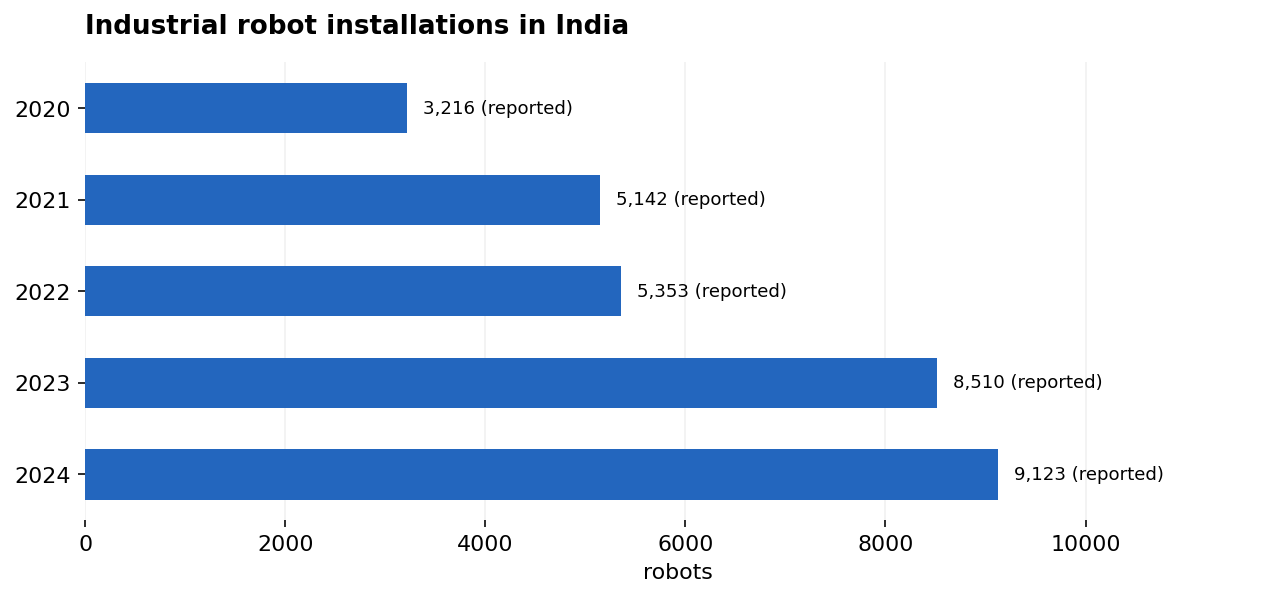
The International Federation of Robotics reports around five million industrial robots operating globally, and an average annual increase of 27% in India’s new installations between 2020 and 2025. India ranked sixth for new installations in 2024.
| Indicator / period | Value (robots) | Data status |
|---|---|---|
| 2020 | 3,216 | reported |
| 2021 | 5,142 | reported |
| 2022 | 5,353 | reported |
| 2023 | 8,510 | reported |
| 2024 | 9,123 | reported |
Technology and industry direction
Robotic welding, machine tending, inspection and material handling can improve repeatability and reduce exposure to hazardous tasks. Collaborative robots and autonomous mobile robots extend automation to different production environments, provided the complete application is risk assessed.
Robot selection requires payload, reach, repeatability, cycle time and environmental ratings. End effectors, vision, safety interlocks and fixtures often determine cell performance more than the arm itself. Simulation can evaluate collisions and throughput, while commissioning validates real-world tolerances. Collaborative operation requires application-level risk assessment rather than assuming every cobot installation is inherently safe.
Business and engineering opportunities
System integrators can deliver grippers, vision systems, safety controls, offline programming and maintenance. MSMEs should begin with repeatable bottlenecks where cycle time, scrap and utilisation are measurable.
Integrators can offer machine tending, vision inspection and palletising as modular solutions. Buyers should model payback from quality, uptime, labour redeployment and maintenance, not simply headcount reduction. Training operators and maintenance teams is essential to sustain the initial performance improvement.
Challenges and outlook
Robot purchases alone do not guarantee productivity. Fixture quality, integration downtime, safety validation and operator training affect return on investment. Installed stock and annual installations are different indicators.
Track installations, utilisation, local integrator capacity and robot density separately. Skills in PLCs, motion control, machine vision and functional safety are transferable across automotive, electronics and logistics.
Connect with the industry at Edgeline Expo 2027
Edgeline Engineering & Innovation Exhibition 2027 invites businesses, researchers and engineering institutions working in robotics to explore product demonstrations, potential customer engagement and industry–academia collaboration from 26–29 January 2027 at Pune International Exhibition & Convention Centre (PIECC), Moshi, Pune. Explore exhibition opportunities.