

Motorsports provides a demanding environment for iterative engineering, especially in chassis, controls, thermal management and vehicle dynamics. Unlike road-vehicle manufacturing, competition prioritises performance within a rule set. Its value to industry lies in disciplined testing and talent development, not an assumed equivalence between racing and mass-market automotive sales.
Market evidence and growth indicators
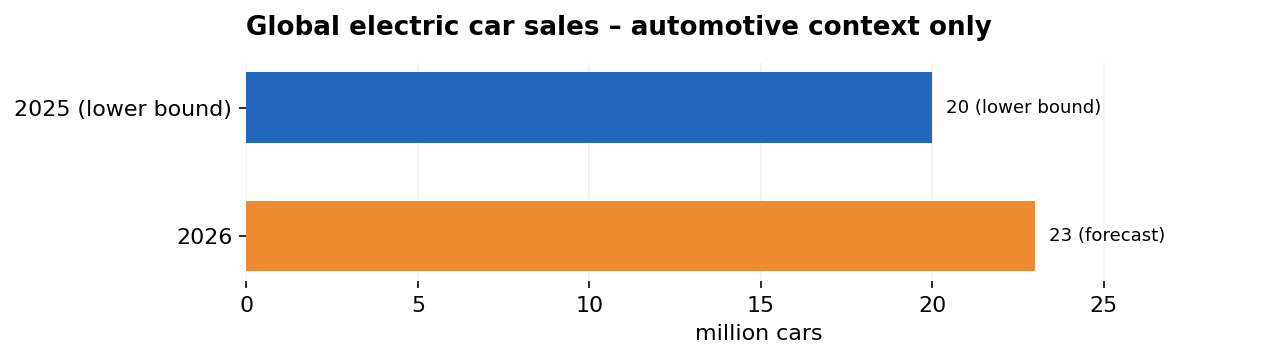
The IEA reports more than 20 million electric cars sold worldwide in 2025. This is a contextual automotive demand indicator, not a motorsports market estimate. No comparable India/global motorsports revenue series is asserted here.
| Indicator / period | Value (million cars) | Data status |
|---|---|---|
| 2025 (lower bound) | 20 | lower bound |
| 2026 | 23 | forecast |
Technology and industry direction
Competition vehicles provide a controlled engineering environment to evaluate chassis stiffness, braking, thermal behaviour, data acquisition and driver interaction. Short development cycles encourage teams to formulate hypotheses, instrument prototypes and compare measured performance with simulations.
A development team begins with requirements, mass distribution and load cases before choosing geometry and materials. Simulation must be checked against physical measurements. Data acquisition can record wheel speed, acceleration and temperatures to compare design changes. Safety inspection and controlled testing are prerequisites for meaningful performance evaluation.
Business and engineering opportunities
Indian component suppliers, simulation companies and engineering colleges can collaborate on telemetry, lightweight fabrication, battery enclosures and powertrain testing. Student competitions can teach design reviews, cost control and failure analysis alongside vehicle performance.
Engineering suppliers can offer simulation tools, sensors, test equipment, fabrication and driver safety equipment. Student teams can demonstrate design reasoning, cost control and validation to potential employers. Companies should evaluate projects through documented evidence rather than race results alone.
Challenges and outlook
Race performance does not automatically translate to road-car durability, affordability or regulatory compliance. Transferable ideas require further validation under representative operating conditions. Safety inspection and disciplined testing are fundamental.
The EV chart is contextual and is not motorsports revenue. Relevant sector measures would include competition participation, sponsorship, engineering services and testing activity, but comparable India/global figures are not established in the cited material. Careers include vehicle dynamics, CAD, telemetry and systems integration.
Connect with the industry at Edgeline Expo 2027
Edgeline Engineering & Innovation Exhibition 2027 invites businesses, researchers and engineering institutions working in motorsports to explore product demonstrations, potential customer engagement and industry–academia collaboration from 26–29 January 2027 at Pune International Exhibition & Convention Centre (PIECC), Moshi, Pune. Explore exhibition opportunities.