
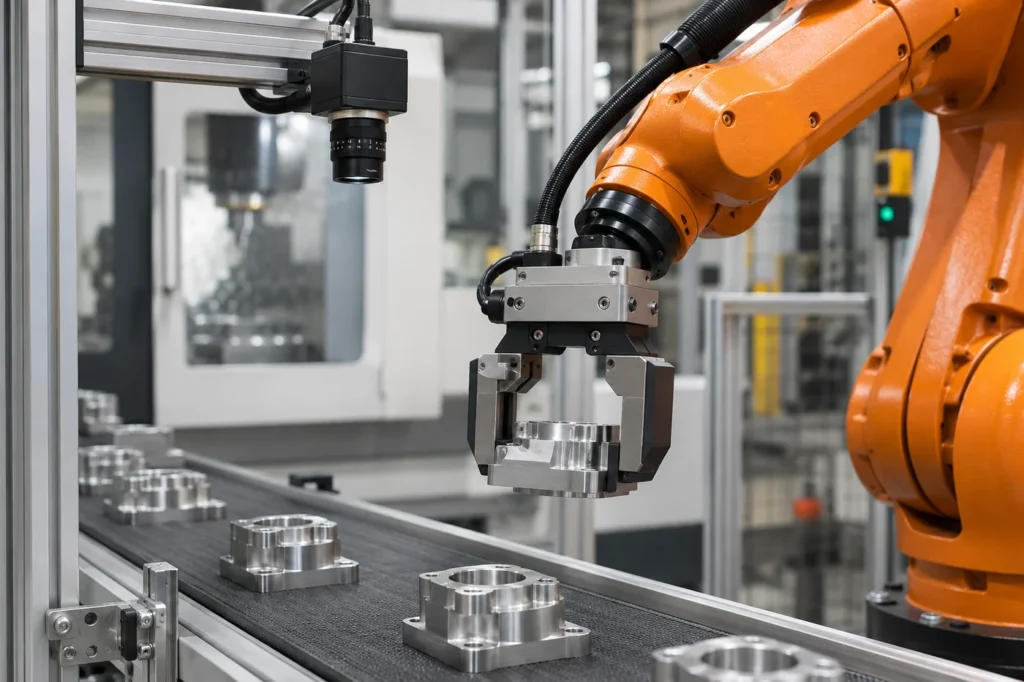
Industrial automation spans process control, discrete manufacturing, inspection and production planning. Industry 4.0 emphasises connected equipment and data-driven operation; Industry 5.0 adds human-centric and sustainability considerations. Indian factories vary substantially in digital maturity, making phased modernisation more realistic than universal full automation.
Market evidence and growth indicators
India’s Economic Survey 2024–25 highlights support for smart manufacturing through SAMARTH Udyog centres. IFR data show Indian robot installations grew at an average 27% annually over 2020–2025, a useful adoption indicator rather than a measure of the entire automation market.
The last value shown is 183.7% higher than the first. This is a comparison of the stated indicators, not an independently measured annual growth rate.
| Indicator / period | Value (robots) | Data status |
|---|---|---|
| 2020 | 3,216 | reported |
| 2024 | 9,123 | reported |

Technology and industry direction
Industry 4.0 links controllers, production data and digital models. Industry 5.0 adds emphasis on human-centred operations, resilience and sustainability. A modern factory may combine PLCs, SCADA, MES, digital twins and manual workstations rather than replace every legacy machine.
PLC programmes coordinate sensors and actuators; SCADA provides supervisory visibility, while manufacturing execution systems manage production records. Variable-frequency drives regulate motor speed and can reduce energy use in suitable applications. Digital twins are useful when models remain aligned with real equipment. Safety systems must remain independent where required by risk assessment.
Business and engineering opportunities
Automation providers can target machine retrofits, traceability, energy optimisation, predictive maintenance and operator assistance. Demonstrations should quantify first-pass yield, downtime and changeover time.
System integrators can target brownfield upgrades, energy optimisation, traceability and quality control. Project contracts should define interfaces, commissioning tests and service response. A factory should measure overall equipment effectiveness, scrap and changeover time before selecting a technology.
Challenges and outlook
Fragmented data, obsolete controls and weak cybersecurity can turn digitalisation into a liability. Projects should be phased, with clearly defined interfaces and acceptance tests.
Robot counts are only one adoption proxy, not total automation revenue. Track actual productivity, energy intensity and system availability. Maintenance technicians, controls engineers and industrial data specialists will be important for successful implementation.
Connect with the industry at Edgeline Expo 2027
Edgeline Engineering & Innovation Exhibition 2027 invites businesses, researchers and engineering institutions working in industrial automation to explore product demonstrations, potential customer engagement and industry–academia collaboration from 26–29 January 2027 at Pune International Exhibition & Convention Centre (PIECC), Moshi, Pune. Explore exhibition opportunities.