
Engineering startups face a different development path from purely digital businesses because prototypes, manufacturing and certification can require substantial capital. India’s broad startup ecosystem provides access to incubators, investors and technical talent, but sector-specific commercialisation depends on customer validation and production readiness.
Market evidence and growth indicators
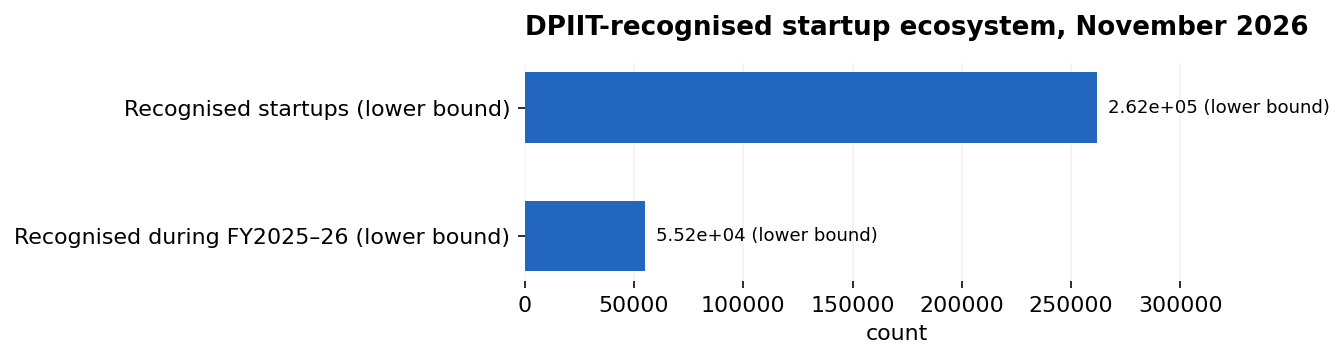
PIB reported more than 2.62 lakh DPIIT-recognised startups in November 2026, up from fewer than 500 in 2014 as reported by the government. India recognised more than 55,200 startups during FY2025–26 alone. These figures cover all sectors, not only engineering.
| Indicator / period | Value (count) | Data status |
|---|---|---|
| Recognised startups (lower bound) | 262,000 | lower bound |
| Recognised during FY2025–26 (lower bound) | 55,200 | lower bound |
Technology and industry direction
Hardware and deep-tech ventures often face longer development cycles than software businesses. Prototypes must evolve into repeatable products through testing, supplier qualification, intellectual property strategy and customer discovery. Global competition rewards reliability and differentiated performance.
A hardware venture should move from proof of concept to engineering validation, design validation and production validation. Requirements, bills of materials, test evidence and supplier qualification reduce risks as production scales. Intellectual property and freedom-to-operate assessments can support investment decisions, while field feedback should guide product revisions.
Business and engineering opportunities
Engineering startups can pursue industrial pilots, licensing, contract development and manufacturing partnerships. Incubators, universities and established manufacturers can provide access to facilities and technical mentorship.
Startups can target industrial problems with measurable economic value, such as inspection, energy efficiency and specialised components. Paid pilots and repeat orders are stronger signals than demonstration attendance. Founders should calculate unit economics including warranty, installation and service, not only manufacturing cost.
Challenges and outlook
Recognition is not proof of active operations, funding or profitability. Capital requirements, certification and lengthy enterprise procurement make cash-flow management and milestone-based financing critical.
DPIIT counts include all sectors and are not engineering startup totals. Track engineering-specific investment, survival, revenue and customer retention where reliable data exist. Partnerships with manufacturers and research institutions can help bridge the gap between prototype and commercial product.
Connect with the industry at Edgeline Expo 2027
Edgeline Engineering & Innovation Exhibition 2027 invites businesses, researchers and engineering institutions working in engineering startups to explore product demonstrations, potential customer engagement and industry–academia collaboration from 26–29 January 2027 at Pune International Exhibition & Convention Centre (PIECC), Moshi, Pune. Explore exhibition opportunities.