
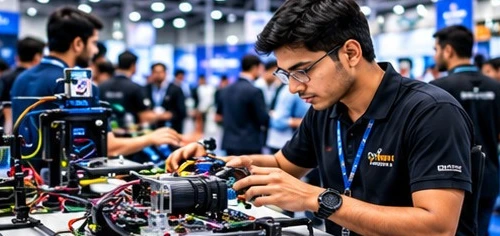
Engineering education is central to industrial capability because new technologies require workers who can design, manufacture and maintain complex systems. India’s scale creates a substantial talent pool, but enrolment alone cannot establish job readiness. International engineering education increasingly emphasises experiential learning and interdisciplinary systems thinking.
Market evidence and growth indicators
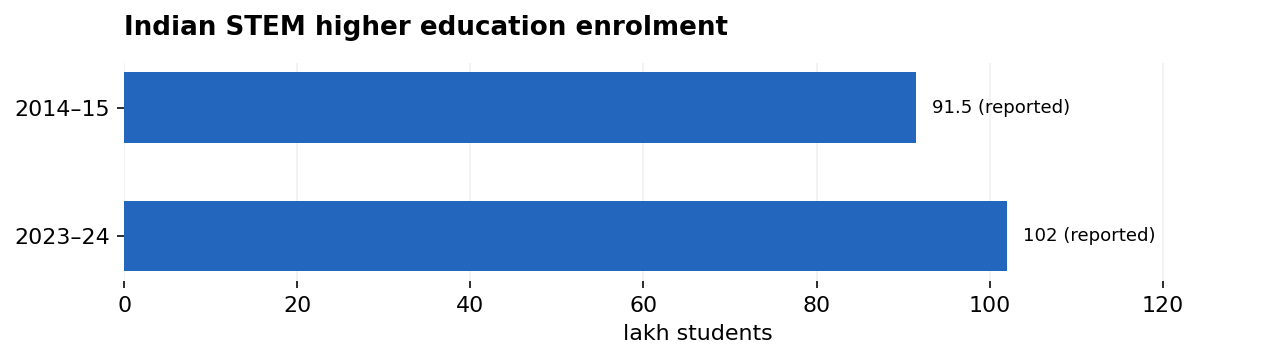
The Ministry of Education’s July 2026 AISHE release reports Indian STEM enrolment increased from 91.5 lakh in 2014–15 to 1.02 crore in 2023–24, approximately 11.5%. STEM enrolment is broader than engineering alone and does not measure employability.
The last value shown is 11.5% higher than the first. This is a comparison of the stated indicators, not an independently measured annual growth rate.
| Indicator / period | Value (lakh students) | Data status |
|---|---|---|
| 2014–15 | 91.5 | reported |
| 2023–24 | 102 | reported |
Technology and industry direction
International engineering practice increasingly combines mechanical systems, electronics, software and sustainability. Students need to move beyond isolated coursework toward interdisciplinary design, documented testing and communication with manufacturing teams.
A meaningful project links requirements, design, implementation and verification. Embedded systems laboratories, EV test benches and manufacturing projects can expose students to real constraints. Assessment should reward documentation, fault diagnosis and reproducible results rather than only demonstrations. Industry mentors can connect theory with production practices.
Business and engineering opportunities
Colleges and employers can co-develop laboratories, capstone projects, internships and faculty training. Industry-led problem statements can expose students to real cost, reliability and schedule constraints. Assessment should include evidence of individual contribution and test results.
Institutions can collaborate with companies on internships, shared laboratories and applied research. Employers should define competency requirements and use practical assessments. Training providers can offer modular learning aligned to specific roles, with clear evidence of outcomes.
Challenges and outlook
Enrolment growth does not prove a reduction in the skills gap. Access to equipment, mentor time and meaningful internships varies widely. Training outcomes need independent evaluation.
Track completion, practical competency, placement quality and research collaboration. STEM data cover more than engineering and cannot be interpreted as employability statistics. Strong fundamentals, communication and safe laboratory practice remain essential.
Connect with the industry at Edgeline Expo 2027
Edgeline Engineering & Innovation Exhibition 2027 invites businesses, researchers and engineering institutions working in engineering education to explore product demonstrations, potential customer engagement and industry–academia collaboration from 26–29 January 2027 at Pune International Exhibition & Convention Centre (PIECC), Moshi, Pune. Explore exhibition opportunities.