
Embedded systems have evolved from isolated microcontroller boards into networked products that combine real-time control, communication and software updates. India has a substantial engineering-services ecosystem, but the transition from contract development to ownership of reusable product platforms is particularly important. Globally, automotive electronics, industrial equipment and medical instrumentation create demand for long-lived, reliable computing platforms.
Market evidence and growth indicators
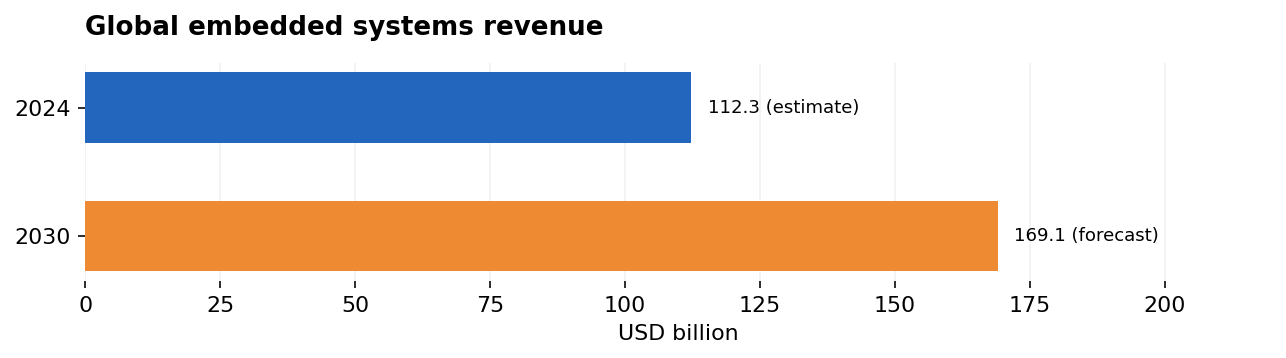
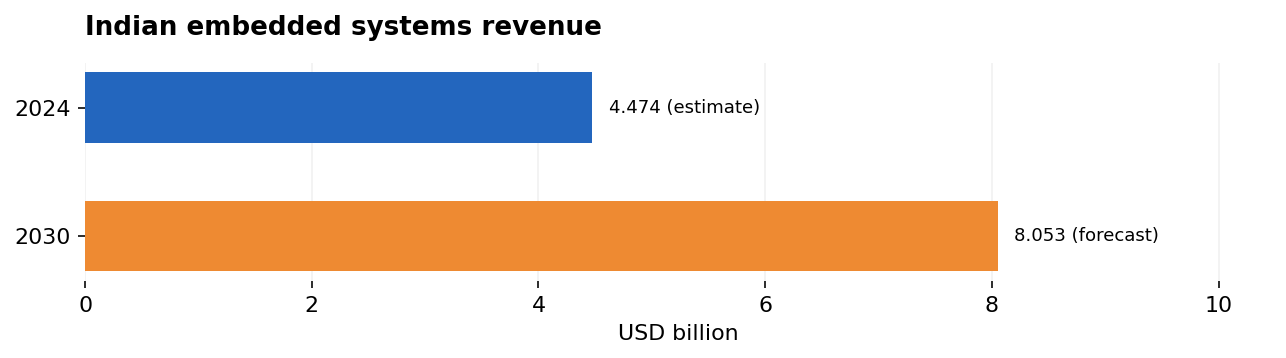
Grand View Research estimates India’s embedded systems market at $4.4745 billion in 2024 and forecasts $8.0527 billion by 2030. Globally, the corresponding estimates are $112.3 billion and $169.1 billion. India’s projected expansion of about 80% exceeds global projected growth of about 51%.
The projected Indian compound annual growth rate implied by the 2024 and 2030 endpoints is approximately 10.3%. The Indian market definition and global research coverage must be consistent before interpreting differences in growth rates.
The last value shown is 80.0% higher than the first. This is a comparison of the stated indicators, not an independently measured annual growth rate. It depends on the forecast being realised.
| Indicator / period | Value (USD billion) | Data status |
|---|---|---|
| 2024 | 4.4745 | estimate |
| 2030 | 8.0527 | forecast |
Technology and industry direction
Embedded computing brings sensing, processing and control into physical products. Electric powertrains require deterministic control, battery monitoring and communication, while factories use embedded controllers to operate drives and inspection equipment. Edge AI is adding local inference to devices that previously sent every reading to a server.
A vehicle battery management system illustrates the engineering stack: voltage and temperature acquisition feed state estimation, protection logic and communications. A real-time operating system schedules tasks against deadlines; CAN or Ethernet interfaces connect the controller to other subsystems. Verification should include fault injection, timing measurements, electromagnetic compatibility and environmental testing. RISC-V and edge inference offer design flexibility, but adoption depends on mature toolchains and validated software.
Business and engineering opportunities
PCB design, firmware development, RTOS integration, CAN diagnostics, industrial gateways and hardware-in-the-loop testing are promising supplier capabilities. Buyers can evaluate platforms against latency, power consumption, environmental reliability and lifecycle support rather than processor speed alone.
A supplier can differentiate through a validated reference design, a maintained firmware library or a specialised test bench. Indian customers in automotive and industrial automation need local engineering support, documentation and predictable component availability. Export customers additionally expect traceable releases, security maintenance and evidence of compliance with applicable product standards.
Challenges and outlook
Imported components, product certification, security patching and long-term component availability remain significant constraints. Engineers need practical experience with C/C++, debugging, communication buses and requirements-based verification.
Track design wins, production volumes, component localisation and recurring software support separately. A revenue forecast is not a guaranteed order book; procurement decisions depend on qualification and total lifecycle cost. Careers in firmware, PCB design, embedded Linux and hardware-in-the-loop verification become more valuable when engineers can demonstrate complete working systems.
Connect with the industry at Edgeline Expo 2027
Edgeline Engineering & Innovation Exhibition 2027 invites businesses, researchers and engineering institutions working in embedded systems to explore product demonstrations, potential customer engagement and industry–academia collaboration from 26–29 January 2027 at Pune International Exhibition & Convention Centre (PIECC), Moshi, Pune. Explore exhibition opportunities.