
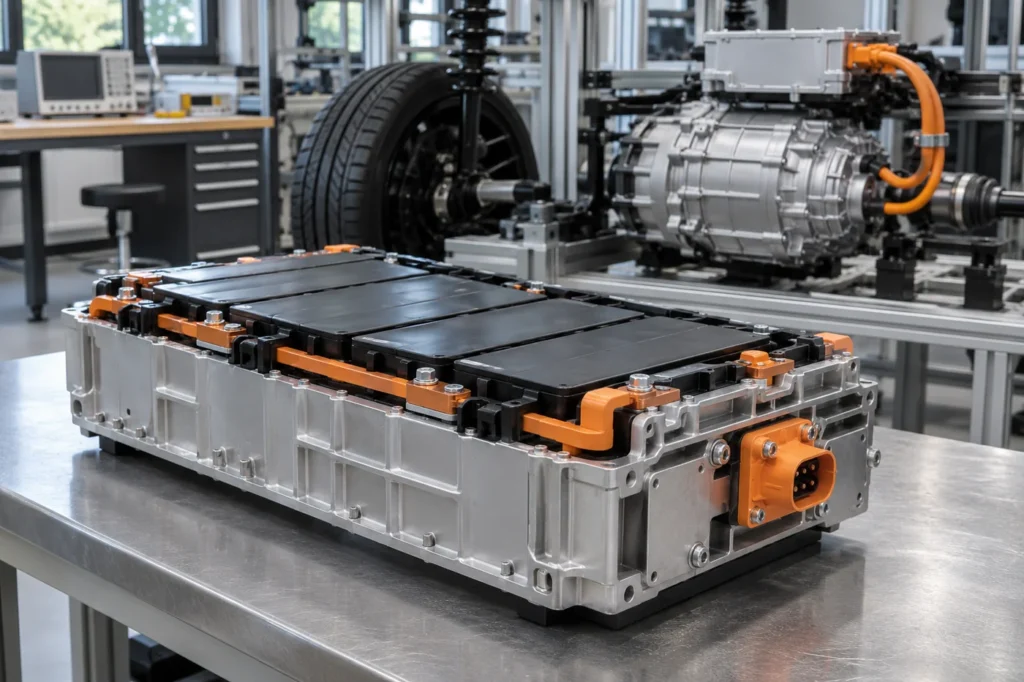
Battery manufacturing is a multi-stage industrial process extending from mineral refining to electrode manufacture, cell assembly and pack integration. Global supply is concentrated, making diversification and recycling relevant to India. Stationary storage and commercial transport introduce distinct lifetime, cost and power requirements beyond passenger vehicles.
Market evidence and growth indicators
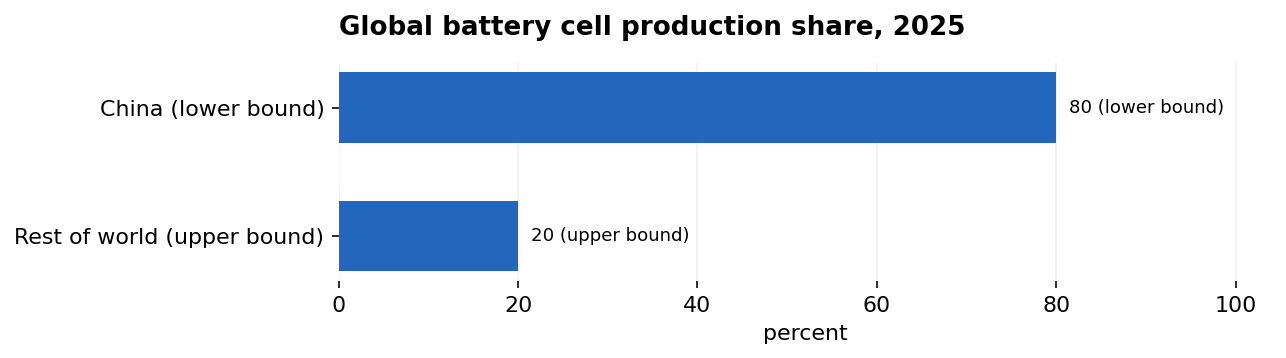
The IEA’s Global EV Outlook 2026 reports that China produced over 80% of battery cells globally in 2025. Electric truck battery demand more than doubled that year. These measures show both geographic concentration and growing demand beyond passenger cars.
| Indicator / period | Value (percent) | Data status |
|---|---|---|
| China (lower bound) | 80 | lower bound |
| Rest of world (upper bound) | 20 | upper bound |
Technology and industry direction
Lithium iron phosphate offers a useful balance of cost and durability for many applications; nickel-rich chemistries can offer higher energy density. Sodium-ion and solid-state technologies are developing, but their commercial readiness varies by application. Pack engineering remains critical regardless of cell chemistry.
Lithium iron phosphate typically trades energy density for cost and thermal stability relative to many nickel-rich chemistries. Sodium-ion is being explored for applications where mass and volume are less restrictive. Pack design requires cell matching, thermal propagation mitigation, current sensing and state-of-health estimation. Formation and ageing influence factory throughput and quality.
Business and engineering opportunities
Indian companies can participate through battery management systems, thermal interfaces, pack assembly, cell testing, recycling and stationary storage integration. A supplier should demonstrate cycle-life testing under realistic temperatures and charging profiles.
Indian businesses can enter pack integration, enclosure fabrication, cooling systems, BMS, testing and recycling before pursuing capital-intensive cell manufacture. Buyers should request traceability, abuse-test evidence and warranty conditions matched to actual operating temperatures and charge rates. Recycling economics depend on collection logistics and material recovery yields.
Challenges and outlook
Raw material dependence, thermal propagation, uncertain recycling economics and warranty liabilities require careful engineering. Global cell production share is not India’s battery market revenue.
Track commissioned cell capacity, actual utilisation, scrap rate, pack prices and end-of-life recovery. Chemistry selection must be application-specific; a promising laboratory result is not equivalent to commercially qualified production.
Connect with the industry at Edgeline Expo 2027
Edgeline Engineering & Innovation Exhibition 2027 invites businesses, researchers and engineering institutions working in battery technology to explore product demonstrations, potential customer engagement and industry–academia collaboration from 26–29 January 2027 at Pune International Exhibition & Convention Centre (PIECC), Moshi, Pune. Explore exhibition opportunities.