

Software-defined vehicles shift functionality towards reusable software platforms and updateable electronic architectures. This affects conventional as well as electric vehicles. India’s automotive engineering and software-services capabilities create a potential bridge between physical vehicle manufacture and software development.
Market evidence and growth indicators
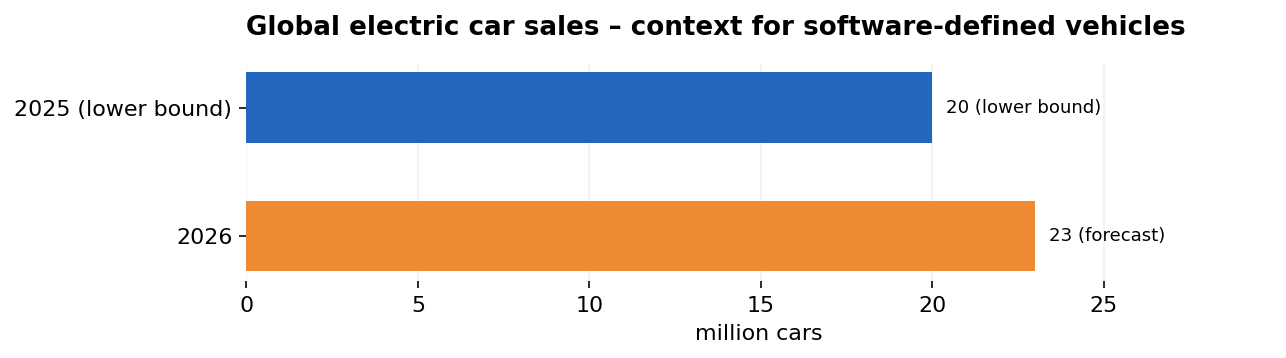
Deloitte’s 2026 Global Automotive Consumer Study India release reports about 95% of surveyed Indian consumers were willing to pay for SDV capabilities. The IEA also records over 20 million electric car sales globally in 2025. Consumer survey responses are not realised purchases.
| Indicator / period | Value (million cars) | Data status |
|---|---|---|
| 2025 (lower bound) | 20 | lower bound |
| 2026 | 23 | forecast |
Technology and industry direction
Software-defined vehicles increasingly separate software functions from individual hardware controllers through centralised or zonal architectures. Over-the-air updates, diagnostics and connected features can support a vehicle throughout its lifecycle, subject to appropriate safety and security controls.
Centralised and zonal architectures can consolidate functions but increase integration complexity. Automotive Ethernet, CAN and middleware connect domains with different latency and safety needs. Over-the-air updates require authentication, rollback strategies and configuration management. Functional safety and cybersecurity must be addressed throughout development.
Business and engineering opportunities
Indian suppliers can build middleware, AUTOSAR integration, diagnostic software, test automation and simulation environments. OEMs need traceability between requirements, code and test results, especially for safety-related functions.
Suppliers can develop diagnostics, middleware, simulation, test automation and fleet software. OEMs should evaluate maintainability, interoperability and long-term support alongside feature count. Consumer survey willingness to pay must be tested against actual pricing and market adoption.
Challenges and outlook
Cybersecurity, update recovery, functional safety and long-term support are essential. Survey enthusiasm does not establish willingness to pay a specific price or subscribe to every feature.
The EV sales chart is context, not SDV sales. Track vehicles with deployed software capabilities, update reliability and validated customer value. Skills in embedded software, network engineering, safety and systems integration are increasingly relevant.
Connect with the industry at Edgeline Expo 2027
Edgeline Engineering & Innovation Exhibition 2027 invites businesses, researchers and engineering institutions working in automotive engineering to explore product demonstrations, potential customer engagement and industry–academia collaboration from 26–29 January 2027 at Pune International Exhibition & Convention Centre (PIECC), Moshi, Pune. Explore exhibition opportunities.