

Advanced manufacturing encompasses precision machining, additive manufacturing, digital production and high-quality mass manufacture. India’s industrial clusters benefit from supplier proximity, logistics and specialised labour, but regional concentration also reveals uneven capability. Global buyers increasingly assess resilience, quality and delivery alongside labour cost.
Market evidence and growth indicators
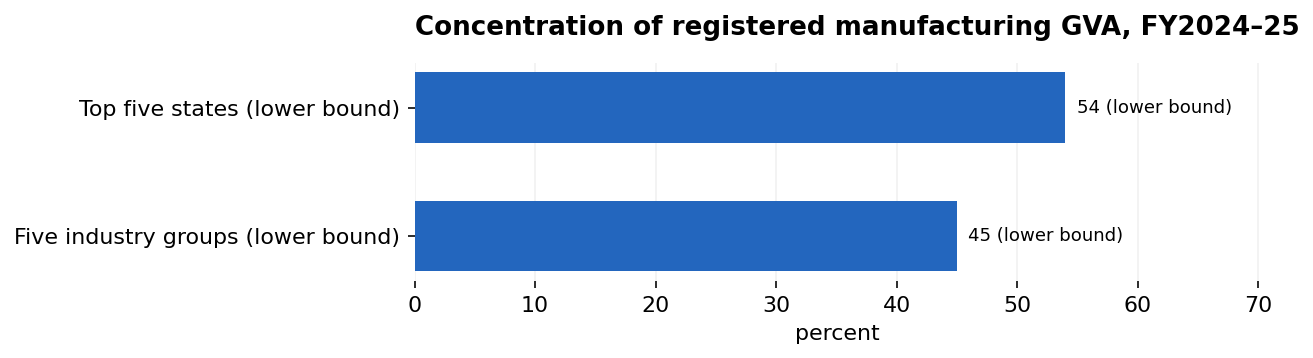
The Annual Survey of Industries for FY2024–25 reports that Maharashtra, Gujarat, Tamil Nadu, Karnataka and Uttar Pradesh together accounted for more than 54% of registered manufacturing GVA. Basic metals, motor vehicles, chemicals, pharmaceuticals and food products together contributed over 45%.
| Indicator / period | Value (percent) | Data status |
|---|---|---|
| Top five states (lower bound) | 54 | lower bound |
| Five industry groups (lower bound) | 45 | lower bound |
Technology and industry direction
Global manufacturers balance cost with delivery reliability, quality and supply-chain resilience. India can compete through engineering depth, supplier development and process capability, not simply inexpensive labour. Pune’s automotive and industrial ecosystem illustrates the importance of supplier proximity.
CNC machining requires process planning, tool management and dimensional verification. Additive manufacturing can enable complex geometries but demands material qualification and post-processing. Metrology, statistical process control and traceability are central to consistent output. Digital production planning helps manage capacity and variability.
Business and engineering opportunities
Precision machining, tooling, additive manufacturing, metrology, industrial software and contract manufacturing are relevant opportunities. Suppliers should demonstrate process capability, material traceability and realistic lead times.
MSMEs can move from commodity job work to validated assemblies, specialised fixtures and precision components. Buyers should examine process capability, defect rates, delivery and engineering change control. Shared testing facilities can lower the qualification burden for smaller companies.
Challenges and outlook
Infrastructure gaps, energy costs, access to capital and inconsistent quality can prevent scale. GVA measures value added, not gross sales or exports; the survey covers registered factories.
Track real GVA, capacity utilisation, productivity and exports rather than assuming every investment creates equivalent output. The state and industry shares overlap and must not be added. Skills in CAD/CAM, materials, metrology and production engineering remain foundational.
Connect with the industry at Edgeline Expo 2027
Edgeline Engineering & Innovation Exhibition 2027 invites businesses, researchers and engineering institutions working in advanced manufacturing to explore product demonstrations, potential customer engagement and industry–academia collaboration from 26–29 January 2027 at Pune International Exhibition & Convention Centre (PIECC), Moshi, Pune. Explore exhibition opportunities.