

Infrastructure investment creates demand for construction equipment, materials, design services and monitoring systems. India’s urbanisation and transport networks provide diverse project opportunities, while global construction faces similar pressure to improve productivity and reduce lifecycle emissions. Spending projections are not the same as contractor revenue.
Market evidence and growth indicators
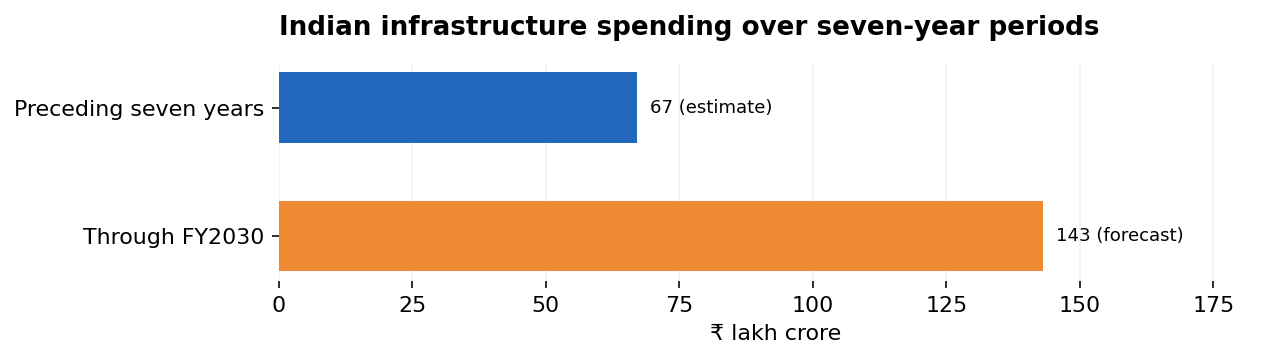
IBEF cites CRISIL’s 2023 infrastructure outlook projecting nearly ₹143 lakh crore of Indian infrastructure spending over seven fiscal years through 2030, versus about ₹67 lakh crore over the preceding seven years. This is a spending projection, not construction industry revenue.
The last value shown is 113.4% higher than the first. This is a comparison of the stated indicators, not an independently measured annual growth rate. It depends on the forecast being realised.
| Indicator / period | Value (₹ lakh crore) | Data status |
|---|---|---|
| Preceding seven years | 67 | estimate |
| Through FY2030 | 143 | forecast |
Technology and industry direction
Globally, building information modelling, prefabrication and digital asset management are changing how infrastructure is designed and maintained. India can use these tools to improve coordination across roads, industrial buildings, utilities and urban transport.
Building information modelling coordinates geometry, quantities and project information. Prefabrication shifts work into controlled factory environments, while structural health monitoring uses sensors to identify changes in performance. Low-carbon materials must meet strength, durability and exposure requirements. Geotechnical investigation remains critical before design decisions.
Business and engineering opportunities
Opportunities include structural health monitoring, precast components, survey technology, construction machinery, low-carbon materials and BIM services. Procurement teams should assess lifecycle cost as well as initial capital cost.
Suppliers can offer precast systems, surveying, building controls, water treatment and construction automation. Project owners should compare whole-life cost, maintenance and commissioning rather than only initial capital expenditure. Local compliance and site-specific engineering remain indispensable.
Challenges and outlook
Land acquisition, financing, contract execution and interoperability can delay projects. Sensor systems and digital models need continued maintenance after construction is complete.
Track project awards, completed assets and operating performance separately. Delays, financing and land acquisition can alter spending trajectories. Engineers with digital modelling, project controls and materials expertise can improve delivery certainty.
Connect with the industry at Edgeline Expo 2027
Edgeline Engineering & Innovation Exhibition 2027 invites businesses, researchers and engineering institutions working in civil & construction to explore product demonstrations, potential customer engagement and industry–academia collaboration from 26–29 January 2027 at Pune International Exhibition & Convention Centre (PIECC), Moshi, Pune. Explore exhibition opportunities.