
Aerospace includes civil aviation, defence aircraft, satellites, launch systems and their supporting services. These markets differ in procurement cycles and certification. India’s space-sector reforms provide a specific growth indicator, while aviation maintenance and component manufacture offer separate commercial opportunities that should not be conflated with space revenue.
Market evidence and growth indicators
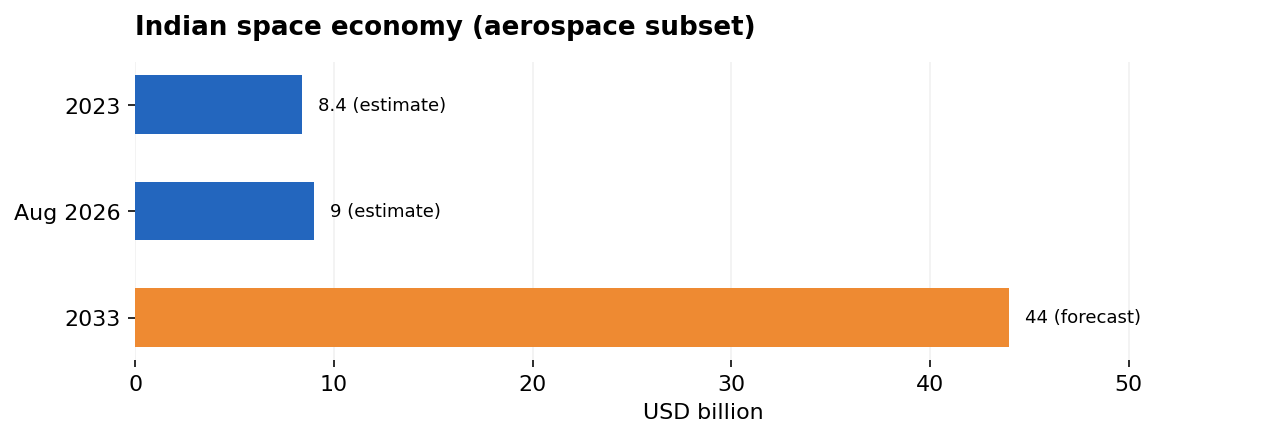
Government reporting in November 2026 estimates India’s space economy at about $9 billion in August 2026, against $8.4 billion in 2023. The government projects approximately $44 billion by 2033, around 8% of global space activity. This is a space-sector indicator, not total aerospace revenue.
The last value shown is 423.8% higher than the first. This is a comparison of the stated indicators, not an independently measured annual growth rate. It depends on the forecast being realised.
| Indicator / period | Value (USD billion) | Data status |
|---|---|---|
| 2023 | 8.4 | estimate |
| Aug 2026 | 9 | estimate |
| 2033 | 44 | forecast |
Technology and industry direction
Aerospace and space programmes require exceptional reliability, lightweight structures, precision manufacturing and rigorous configuration management. Commercial aviation, satellites and ground infrastructure have different certification and operating environments.
Satellite systems combine structures, thermal management, power, communications and attitude control. Aircraft components require rigorous materials traceability, fatigue analysis and manufacturing quality. Lightweight composites and precision machining can reduce mass, but qualification requires representative testing. Digital engineering supports configuration control across long product lifecycles.
Business and engineering opportunities
Suppliers can explore CNC components, composites, avionics, harnesses, thermal management, sensors and non-destructive testing. Downstream space applications also create opportunities in geospatial software and data processing.
Indian suppliers can focus on precision parts, harnesses, ground support equipment, simulation and testing. Entry into aerospace supply chains often requires audited quality systems and customer qualification. Research institutions can collaborate on materials, propulsion and sensing without assuming immediate commercial production.
Challenges and outlook
Qualification cycles are lengthy and failure costs are high. Export controls, traceability, specialist materials and testing infrastructure can limit entry. The 2033 projection is not guaranteed procurement.
Track qualified suppliers, launch and satellite activity, maintenance capability and export orders. The space-economy forecast is not a forecast for the entire aerospace industry. Careers require strong fundamentals in mechanics, electronics, reliability and systems engineering.
Connect with the industry at Edgeline Expo 2027
Edgeline Engineering & Innovation Exhibition 2027 invites businesses, researchers and engineering institutions working in aerospace & space to explore product demonstrations, potential customer engagement and industry–academia collaboration from 26–29 January 2027 at Pune International Exhibition & Convention Centre (PIECC), Moshi, Pune. Explore exhibition opportunities.