
Artificial intelligence is moving from general-purpose analytics into engineering workflows such as visual inspection, design exploration and maintenance. India has a large software talent base, but industrial AI depends on access to representative machine and process data. International competition increasingly involves compute infrastructure, specialised models and deployment capability.
Market evidence and growth indicators
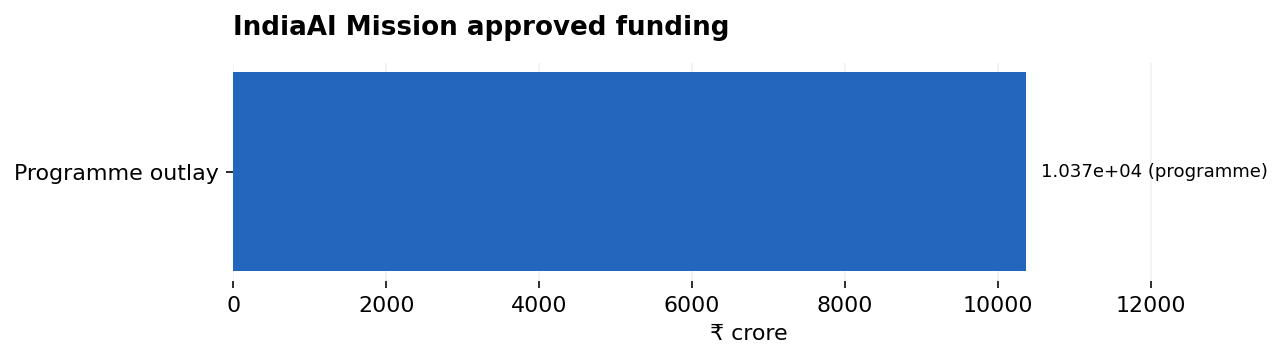
IndiaAI Mission has an approved outlay of about ₹10,372 crore. Government reporting indicates shared compute capacity had expanded to more than 45,000 GPUs by June 2026. These are programme indicators rather than AI industry revenue.
| Indicator / period | Value (₹ crore) | Data status |
|---|---|---|
| Programme outlay | 10,372 | programme |
Technology and industry direction
Internationally, engineering teams are applying machine learning to visual inspection, equipment monitoring, design exploration and document retrieval. Industrial AI differs from consumer AI because false alarms, missed defects and unplanned downtime have measurable costs.
An inspection system requires controlled illumination, labelled defect examples and validation against production variability. Predictive maintenance uses sensor histories to detect deviations, but failures are often rare, making false alarms a serious concern. Edge inference reduces network dependence, while cloud training can handle larger datasets. Model versioning and drift monitoring are operational requirements.
Business and engineering opportunities
Indian developers can combine domain expertise with computer vision, edge deployment, industrial data platforms and model monitoring. Manufacturers should benchmark detection accuracy against existing inspection methods before deployment.
Engineering companies can develop domain-specific inspection, document retrieval and optimisation products. A successful pilot needs a baseline, measurable acceptance criteria and a human review process. Buyers should evaluate latency, data governance, integration cost and accuracy on unseen operating conditions.
Challenges and outlook
Poor training data, model drift, intellectual property leakage and uncertain outputs can undermine performance. Safety-critical decisions require validated safeguards and accountable human oversight.
Public funding and GPU availability are inputs, not realised industrial productivity. Track deployed systems, measurable defect reductions and sustained usage. Engineers who understand both statistical methods and physical processes can bridge the gap between demonstrations and reliable production.
Connect with the industry at Edgeline Expo 2027
Edgeline Engineering & Innovation Exhibition 2027 invites businesses, researchers and engineering institutions working in artificial intelligence to explore product demonstrations, potential customer engagement and industry–academia collaboration from 26–29 January 2027 at Pune International Exhibition & Convention Centre (PIECC), Moshi, Pune. Explore exhibition opportunities.