
Electrification changes the automotive value chain from combustion engines and fuel systems towards electrical machines, power electronics, batteries and charging services. Global markets differ in their incentives and vehicle mix; India’s two- and three-wheeler segments make its transition particularly distinct. Model availability expands consumer choice but does not directly measure vehicle adoption.
Market evidence and growth indicators
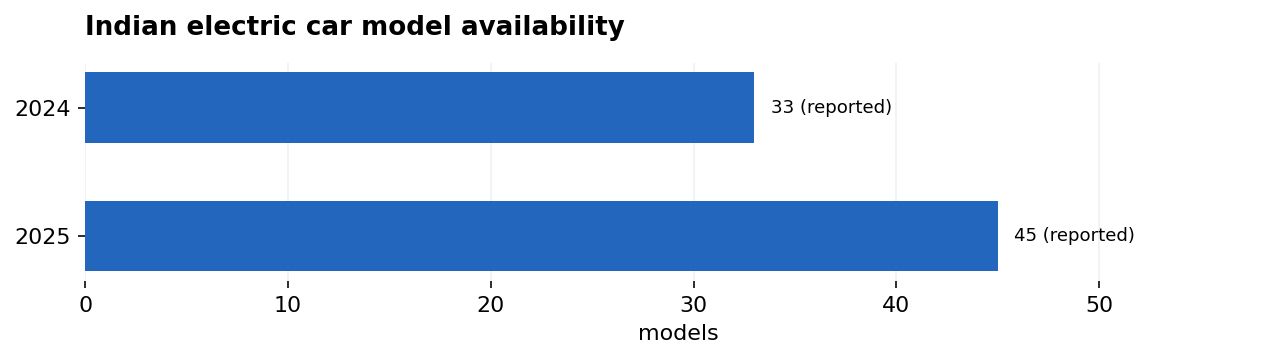
The IEA reports that global electric car sales exceeded 20 million in 2025, rising 20% from 2024. It forecasts 23 million sales in 2026, equivalent to 28% of car sales. In India, available electric car models expanded from 33 in 2024 to 45 in 2025.
The last value shown is 36.4% higher than the first. This is a comparison of the stated indicators, not an independently measured annual growth rate.
| Indicator / period | Value (models) | Data status |
|---|---|---|
| 2024 | 33 | reported |
| 2025 | 45 | reported |
Technology and industry direction
India’s mobility transition differs from markets dominated by passenger cars. Two-wheelers, three-wheelers and commercial fleets offer distinct duty cycles and charging needs. Fleet economics depend on utilisation, energy cost, maintenance and financing rather than purchase price alone.
A traction system converts battery DC power through an inverter into controlled motor torque. Regenerative braking returns some kinetic energy to the pack, subject to traction and battery limits. Thermal management, insulation monitoring and high-voltage interlocks protect occupants and technicians. Charging infrastructure must match connector, power, communications and electrical safety requirements.
Business and engineering opportunities
Motor manufacturers, inverter developers, charging operators, connectors suppliers and vehicle testing companies can address local requirements. Fleet operators need dependable charging and service networks; OEMs need validated components and traceable manufacturing.
Opportunities include motors, wire harnesses, thermal components, charging equipment and fleet energy management. A fleet buyer should compare cost per kilometre using realistic duty cycles, downtime, financing and battery replacement assumptions. Local workshops need diagnostic equipment and high-voltage training, creating a service market alongside manufacturing.
Challenges and outlook
Charging access, grid connections, residual values, battery safety and affordability can slow adoption. Model availability is not the same as sales volume, and the 2026 global figure remains a forecast.
Monitor registrations by vehicle class, public charging reliability and battery warranty performance. Growth may vary by state and use case. Engineering careers increasingly combine electrical machines, vehicle controls, power electronics and system validation.
Connect with the industry at Edgeline Expo 2027
Edgeline Engineering & Innovation Exhibition 2027 invites businesses, researchers and engineering institutions working in electric vehicles to explore product demonstrations, potential customer engagement and industry–academia collaboration from 26–29 January 2027 at Pune International Exhibition & Convention Centre (PIECC), Moshi, Pune. Explore exhibition opportunities.